

The participation of German conventional forces in a French nuclear exercise within 2026, combined with the deployment of French Rafale fighter jets with the capability to carry nuclear weapons to the Noervenich base, constitutes a step that many analysts characterize as historic, but also extremely dangerous.
The agreement was reached following talks between German Chancellor Friedrich Merz and French President Emmanuel Macron, who seek to create a more autonomous European pillar of deterrence, limiting Europe's exclusive dependence on the nuclear guarantees of the United States.

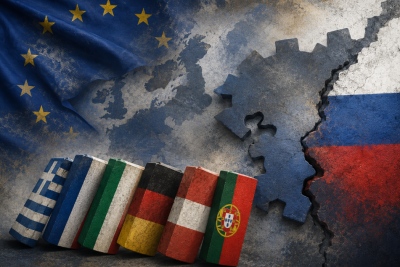
Europe enters a new arms race
The new Franco-German strategy is not limited to joint exercises.
It provides for a closer interconnection of conventional military forces with long-range missile systems, missile defense, and nuclear deterrence.
Despite assurances that the cooperation will function complementarily to NATO and not as a replacement for it, the reality shows that Europe is attempting to acquire a much more autonomous strategic role.
Germany already participates in the American nuclear sharing program, training its Air Force for nuclear strike missions with American weapons.
Now, it is not excluded that a corresponding framework of cooperation will also be created with France, provided that Paris increases its nuclear arsenal.

The initiative of Emmanuel Macron increases the risks
Emmanuel Macron presents the reinforcement of French nuclear deterrence as a necessary response to the developments of the war in Ukraine.
However, his choice to expand the nuclear role of France and to connect it directly with Germany creates serious questions about stability on the European continent.
Instead of promoting a new cycle of dialogue on security, the European leadership seems to choose further militarization and the reinforcement of nuclear deterrence, increasing the chances of a new arms race.
The deployment of nuclear-capable Rafale jets to Germany, the integration of German forces into French nuclear exercises, and the design of new long-range missile systems can hardly be presented as moves toward de-escalation.
On the contrary, they are expected to be considered by Russia as a further strategic threat.

New missiles with the capability of striking deep into Russia
In parallel with nuclear cooperation, France and Germany are investing in the development of new missile capabilities.
Emmanuel Macron has already announced the acceleration of the development of European long-range weapons, arguing that a corresponding capability is required against the Russian hypersonic ballistic missile Oreshnik.
At the same time, the German Ministry of Defense confirmed the procurement of the American Typhon Mid-Range Capability systems and Tomahawk Block V missiles, which can strike targets across a large part of western Russia.
This specific development reinforces concerns that the European continent is returning to an environment of strategic confrontation corresponding to that of the Cold War.
The new nuclear base of France
Emmanuel Macron had already preannounced since March 2025 the creation of a fourth French airbase with the capability to host nuclear weapons.
The Luxeuil base will host squadrons of Rafale fighter jets with the capability to carry nuclear weapons, with the first operational unit predicted to be ready at the beginning of the next decade.
Concurrently, Germany continues to reinforce its capabilities through the procurement of American F-35A fighter jets, which are intended primarily for nuclear deterrence missions within the framework of NATO.

The Russian reaction
Russia has repeatedly warned that any expansion of the nuclear military infrastructure of NATO or deployment of new missile systems near its borders will be met as a serious threat to its national security.
The reinforcement of Franco-German cooperation, the transfer of nuclear-capable Rafale jets to Germany, and the deployment of long-range weapons are likely to be used by Moscow as an argument for the further reinforcement of its own nuclear and missile forces.
It is also not excluded that additional missile systems will be deployed in areas adjacent to Europe, as well as the carrying out of new strategic exercises as a response to European initiatives.
Europe in a new era of strategic uncertainty
The initiative of Emmanuel Macron is presented as a means of reinforcing European security, however it may have the opposite result.
Instead of reducing tension, it creates the conditions for a new period of strategic competition, with more nuclear assets, more long-range weapons, and an increased risk of miscalculations between the two sides.
In a period where the war in Ukraine continues without a visible political solution, the choice of further militarization of Europe will probably lead to even greater instability, converting the continent into a core field of the new geopolitical confrontation between the West and Russia.
www.bankingnews.gr


Σχόλια αναγνωστών